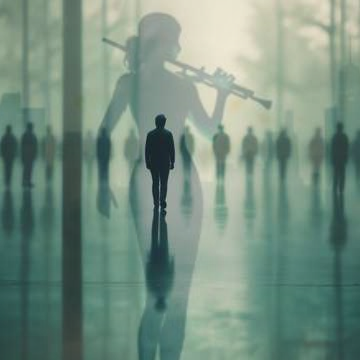
SOMA — A Myth of Return, From the Aughts
A 2025 debut album from FakeFalse
As Leonardo da Vinci once said:
"Art is never finished, only abandoned."
Some works, however, refuse abandonment.
Some songs do not die...
They slip underground. Dormant, patient. Waiting not for perfection, but for the right season to return.
SOMA is the awakening from that long circadian rhythm.
Much of this album was written in 2006, by a younger self who felt deeply, but lacked the language to fully understand what was being felt. These songs arrived early. As impressions, instincts, emotional sketches. Honest, but unfinished. For years they slept quietly, folded into memory, gathering distance rather than dust.
They waited.
What finally called them back was not nostalgia, but recognition. Time did not diminish them. It clarified them. When the vault was opened again, the songs did not ask to be rewritten; they asked to be understood.
What emerged is not a revival, but a continuation.
Reborn through warm circuitry, drifting pads, and low-lit pulses of electronic and ambient Dream-Pop, SOMA carries the sonic language of late-night reflection. Restrained, intimate, and deliberately unhurried. These songs are fuller now, not because they were embellished, but because the person finishing them had lived inside their consequences.
Where they once reached, they now arrive.
Supporting vocalist Amica becomes essential to this transformation. Her presence provides the human counterweight. A voice capable of holding both softness and gravity at once. Her sultry, jazz-inflected delivery glides effortlessly through deep house rhythms and retro electro-funk textures, anchoring the album’s emotional restraint in something unmistakably alive. She does not decorate the songs; she inhabits them.
But SOMA is not simply an album about return.
It is an album about what happens after awareness.
Where my Post-Punk album Double Negative
documented the moment a person wakes up inside a system that was never built for them, SOMA documents all
those variouse scenarioes, before the awakening. Before the clarity. There is only the current experience, and
we are far from that point of awareness. We are currently in it, and the self continues living within the
'truth' it curently recognizes.
Here, anesthesia replaces illusion.
Regulation replaces rupture.
Endurance replaces awakening.
SOMA explores the quiet negotiations we make to remain functional: the rituals that soften absence, the compromises that preserve attachment, the numbness that feels like peace, and the hope that persists even when resolution does not arrive. Love in this album is rarely dramatic. It is patient, deferred, ritualized, sometimes frozen, sometimes impossible.
And sometimes, tragic and endured.
The later additions to the album, songs written in 2025, are not corrections. They are revelations. 'Where Are You Tonight', 'Only the Balcony Remembers', and 'Tu m’fais d’la peine' do not disrupt the record’s cohesion; they complete its emotional geometry. They speak from distance, hindsight, and consequence, naming what could not yet be named when the first songs were written.
Together, they transform SOMA into a dialogue across time:
between youth and maturity,
between longing and recognition,
between what was survived and what was understood.
This album is a bridge between the self that felt without language
and the self that can now speak without illusion;
between silence and sound;
between endurance and acceptance.
If SOMA has a purpose, it is not to resolve pain, but to honor it honestly, without dramatization, without anesthesia masquerading as healing. It reminds us that nothing truly felt is ever lost. It remains in the body, in memory, in music. Always waiting not to be perfected, but to be welcomed back with compassion.
Some works are abandoned. Others wait.
SOMA waited. And when it returned, it reminded me of who I was.
...and who I am!