Halfway to the Moon — Shoegaze to the Stars
What Comes After The Fall?
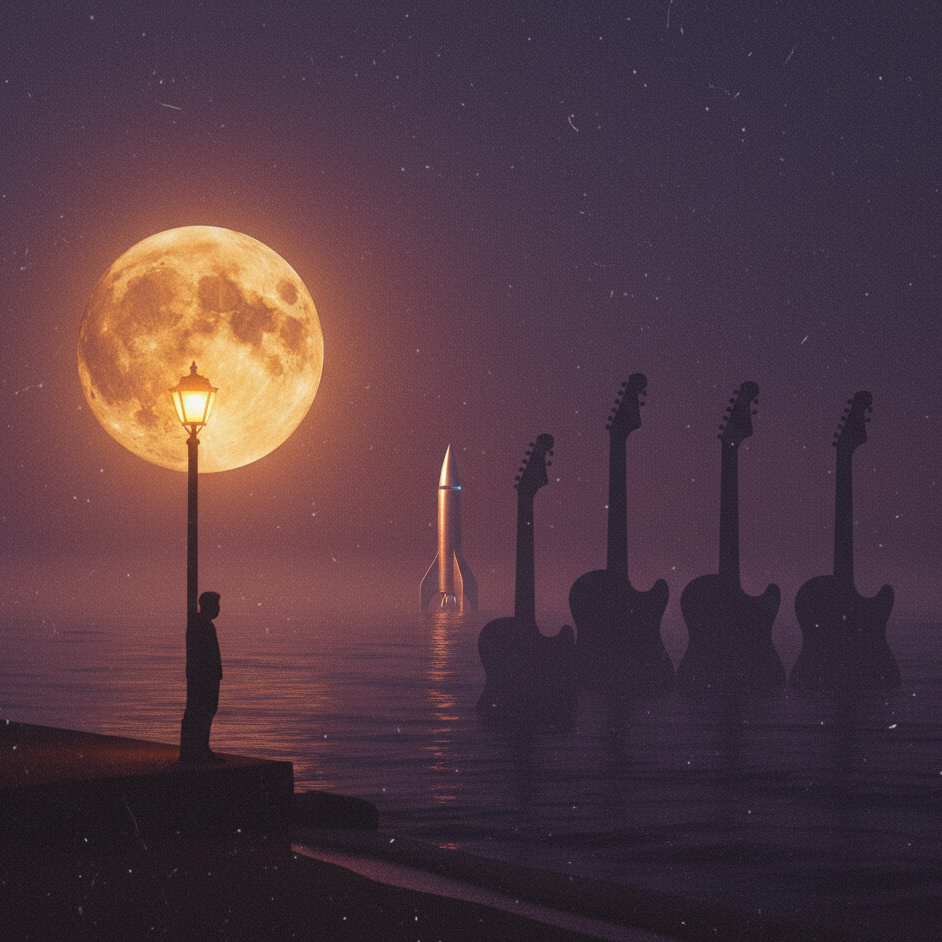
This album documents the passage from survival into intention, from awareness into alignment. It begins in the aftermath of "Double Negative". A record shaped by collapse, friction, and the urgency of waking up, and carries that clarity forward into movement, trust, and lift. What follows is not escape, but ascent: a deliberate journey from gravity-bound introspection toward a weightless, forward-looking possibility.
The record opens on solid ground. Post-punk textures are brooding, taut, and close to the floor. Sounds that press inward, that resist comfort. Within the first track, “Gravity,” those edges begin to soften. Guitars blur, space opens, and shoegaze emerges not as retreat, but as a launch mechanism. Historically, shoegaze was named with a smirk. A critique aimed at bands who appeared inward, eyes fixed on their pedals, seemingly uninterested in spectacle. But that lens misses the truth: shoegaze is devotion. It is craft over performance. Attention over posture. A quiet rebellion against noise for its own sake.
That idea, to focus as power, runs through the entire album.
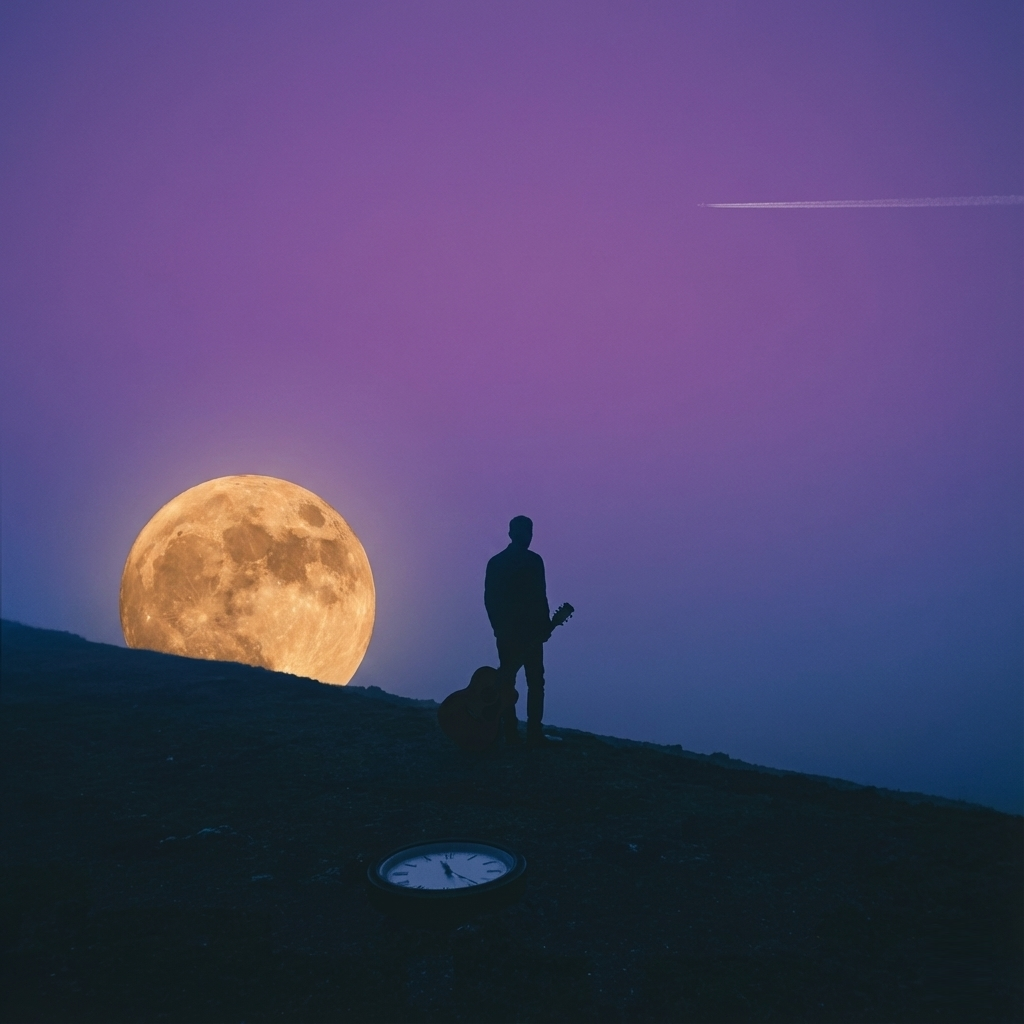
The title Halfway to the Moon traces back to a moment shared with my friend Karim, a steady presence in my creative life. Years ago, I told him to shoot for the moon, and stayed unflinching when he tested the sentiment. That exchange became a private reference point between us—one rooted in trust, openness, and mutual challenge. This album carries that energy forward. In many ways, it is a long-form thank you to a friendship that understood momentum before certainty.
Across eight tracks, the album moves with intention:
from Post-Punk tension, through shoegaze density, and into the open warmth of dream-pop.
The shift is gradual, but unmistakable. The listener rises from the floor, passes through doubt
and experimentation, and arrives in a space of confidence that doesn’t need to announce itself.
Shoegaze becomes the bridge. Dream-Pop becomes the horizon.
Two pivotal moments in that passage are “Piece(s)” and “Fallacy,” both elevated by a young woman by the name of BLT.
 Her voice weaves quietly but decisively beneath the surface. On “Piece(s),” her harmonies gather
the fragments the song wrestles with, adding warmth where the edges might cut. On “Fallacy,” she
returns as a grounding counterpoint, reinforcing the track’s emotional tension. As the song explores
the sunk cost rule in poker. Our tendency to keep investing in a losing hand, her presence becomes
symbolic. Seated at the gambling table, playing her cards as best she can, she embodies the quiet resilience
at the heart of the record. Her voice reminds us that trust in self, shines best through uncertainty.
Her voice weaves quietly but decisively beneath the surface. On “Piece(s),” her harmonies gather
the fragments the song wrestles with, adding warmth where the edges might cut. On “Fallacy,” she
returns as a grounding counterpoint, reinforcing the track’s emotional tension. As the song explores
the sunk cost rule in poker. Our tendency to keep investing in a losing hand, her presence becomes
symbolic. Seated at the gambling table, playing her cards as best she can, she embodies the quiet resilience
at the heart of the record. Her voice reminds us that trust in self, shines best through uncertainty.
Lyrically and thematically, the album explores individuation. Not as isolation, but as integration. It is about learning where to give, where to guard, and how trust in oneself becomes the gravitational center that others respond to. Vulnerability is reshaped. Self-sacrifice becomes conscious. Energy is no longer spent to survive, but invested to build. The record recognizes a quiet quantum truth: observation matters. Choice collapses potential into reality. Small internal shifts change the entire field around you.
By the final track, “Borrowed Time,” gravity hasn’t disappeared. It has softened. Time is no longer a threat, but the mechanism that makes everything precious. The album doesn’t end with arrival, but with ignition. Beyond the moon. Among the stars. And finally, beyond them. Not as conquest, but as curiosity renewed.
Ultimately, "Halfway to the Moon" is about shaping your own universe from the inside out. One small movement at a time. Hands on the wheel. Eyes down. Craft engaged. As you focus on the work. Quietly, and honestly. Everything around you begins to align. In aiming for the moon, you discover something gentler and more powerful: the world moves with you once you learn to trust your own gravity.
So let’s go on this journey together, 'cause after reading all this, we’re already more than halfway there.